Wednesday, May 29, 2019

Oliver Heaviside and theoretical physics


Photo source: Wikimedia Commons

Oliver Heaviside (1850-1925) was an English electrical engineer and physicist best known for reformulating Maxwell's equations. Physicist George Francis Fitzgerald said,
"Maxwell’s treatise is cumbered with the debris of his brilliant lines of assault, of his entrenched camps, of his battles. Oliver Heaviside has cleared those away, has opened up a direct route, has made a broad road, and has explored a considerable tract of country. " (Review of Heaviside's Electrical Papers, 1893)
The rest of this post is some quotes from Heaviside.

Maxwell's equations


"It took me several years before I could understand as much as I possibly could. Then I set Maxwell aside and followed my own course. And I progressed much more quickly… It will be understood that I preach the gospel according to my interpretation of Maxwell." (Quoted in Oliver Heaviside by Paul Nahin)

Mathematics


"In working out physical problems there should be, in the first place, no pretence of rigorous formalism. The physics will guide the physicist along somehow to useful and important results, by the constant union of physical and geometrical or analytical ideas. The practice of eliminating the physics by reducing a problem to a purely mathematical exercise should be avoided as much as possible. The physics should be carried on right through, to give life and reality to the problem, and to obtain the great assistance which the physics gives to the mathematics." (Electromagnetic Theory, 1893)

Theory


"The study of the theory of a physical science should be preceded by some general experimental acquaintance therewith, in order to secure the inimitable advantage of a personal acquaintance with something real and living." (Electromagnetic Theory, 1893)

"Theory always tends to become abstract as it emerges successfully from the chaos of facts by the processes of differentiation and elimination, whereby the essentials and their connections become recognised, whilst minor effects are seen to be secondary or unessential, and are ignored temporarily, to be explained by additional means." (Electromagnetic Theory, 1893)

Reality


"We do not dwell in the Palace of Truth. But, as was mentioned to me not long since, 'There is a time coming when all things shall be found out'. I am not so sanguine myself, believing that the well in which truth is said to reside is really a bottomless pit." (Electromagnetic Theory, 1893)

"There is no absolute scale of size in the Universe, for it is boundless towards the great and also boundless towards the small." (Quoted in On Growth and Form by D'Arcy Wentworth Thompson)

Monday, May 20, 2019

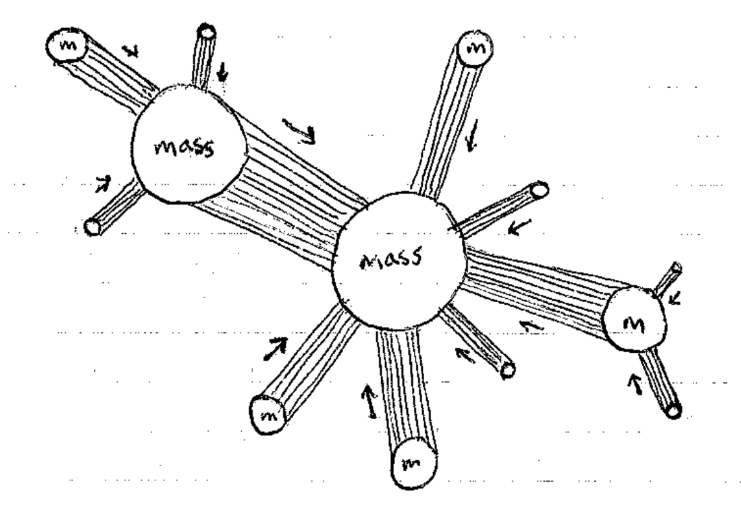
Gravity strings: theory of gravity


Sometimes I believe action at a distance (and time dilation at a distance) is impossible. It doesn't make sense that the Earth can cause a force (or time dilation) on the Moon without actually touching the Moon. For this reason, it seems there should be a connecting object that causes gravity. Regarding action at distance, Isaac Newton once said,
"That gravity should be innate, inherent and essential to matter, so that one body may act upon another at a distance thro' a vacuum, without the mediation of any thing else, by and through which their action and force may be conveyed from one to another, is to me so great an absurdity that I believe no man who has in philosophical matters a competent faculty of thinking can ever fall into it. Gravity must be caused by an agent acting constantly according to certain laws; but whether this agent be material or immaterial, I have left to the consideration of my readers." (Letters to Bentley, 1692-1693)
To address this issue, I created a theory where gravity is caused by subatomic strings (gravity strings) that pull objects together. I dont actually believe this theory, but it serves as a possible template to think action at a distance. Below I've listed a few principles about gravity strings.
  1. Only objects with mass can shoot out gravity strings.
  2. Gravity strings are made of subatomic massless particles.
  3. Massive objects can dispense more gravity strings that can go further distances.
  4. The loose end of a gravity string searches for matter to attach to.
  5. Once attached to an object, a gravity string pulls the object towards itself.
  6. A gravity string forms a straight line between two objects similar to a taught rope.
  7. Gravity strings are extremely thin allowing them to easily pass through larger objects.
  8. Gravity strings can pass through each other because each string has alternating segments of even smaller matter.
  9. Every galaxy contains a web of gravity strings that connect solar systems together.

License: CC BY-SA 4.0

Saturday, April 20, 2019

Fundamentals of physics


Photo source: Wikimedia CommonsEric Hahn
Photo license: CC BY-SA 4.0

This post is an outline of my philosophy of physics. There are 18 principles divided into 5 sections.

    A. What is physics?
  • Physics is the study of matter, motion, force, space and time

    B. Matter
  • Matter consists of matter and extremely small empty space
  • Empty space consists of empty space and extremely small matter
  • Matter consists of infinitely smaller structures and particles
  • Every particle is a unified structure of even smaller matter
  • The properties of matter are determined by its underlying structure
  • Interlocking structures hold a piece of matter together
  • A single particle cannot be in multiple places at once

    C. Motion and force
  • All matter moves according to the forces that are affecting or have affected it
  • Every physical force is matter pushing or pulling other matter by collision
  • Every physical field of force is actually microscopic or hidden matter pushing and pulling
  • Colliding particles can temporarily overlap with their smaller particles on the edge
  • Sometimes subatomic particles can travel straight through other matter
  • A shaking or pulsating particle moving through space moves like a wave

    D. Space
  • There are three spatial dimensions
  • Spatial dimensions above three do not exist

    E. Time
  • Time is the process by which reality moves from past, present to future
  • Without time, matter cannot move

License: CC BY-SA 4.0

Sunday, January 27, 2019

Fundamentals of free will


Photo source: Wikimedia CommonsW.carter
Photo license: CC BY-SA 4.0

This post is a collection of quotes about free will. There are 9 quotes divided into 3 sections.

A. Free will is a faculty that allows a being to make independent choices (3)
B. Consciousness would be evolutionarily useless without free will (3)
C. Emotion guides behavior but does not dictate behavior (3)

A. Free will is a faculty that allows a being to make independent choices


Jacob Bronoswki (1908-1974, mathematician):
1. "What we really mean by free will... is the visualizing of alternatives and making a choice between them." (The Origins of Knowledge and Imagination, 1978)

Charles Sanders Peirce (1839-1914, philosopher):
2. "The truth is, the mind is not subject to 'law' in the same rigid sense that matter is." (The Law of Mind, 1892)

John Dewey (1859-1952, philosopher):
3. "Individuality is the source of whatever is unpredictable in the world." (Time and Individuality, 1940)

B. Consciousness would be evolutionarily useless without free will


David Chalmers (1966-now, philosopher)
4. "Why doesn't all this information-processing go on 'in the dark', free of any inner feel? ...We know that conscious experience does arise when these functions are performed, but the very fact that it arises is the central mystery." (Facing Up to the Problem of Consciousness, 1995)

Amit Goswami (physicist):
5. "In this view, consciousness imposes 'downward causation'. In other words, our free will is real. When we act in the world we are really acting with causal power." (Scientific Proof of the Existence of God, 1997)

Jean-Paul Sartre (1905-1980, philosopher):
6. "Imagination is not an empirical or superadded power of consciousness, it is the whole of consciousness as it realizes its freedom." (1936, Imagination: A Psychological Critique)

C. Emotion guides behavior but does not dictate behavior


G. E. Moore (1873-1958, philosopher):
7. "Moral conduct, or duty, is defined as the obligation to select that action which will achieve more good than any alternative action..." (Goodreads.com)

Simone de Beauvoir (1908-1986, philosopher):
8. "I wish that every human life might be pure transparent freedom." (The Blood of Others, 1946)

Sigmund Freud (1856-1939, psychologist):
9. "The ego represents what we call reason and sanity, in contrast to the id which contains passions." (The Ego and the Id, 1923)

Fundamentals of God


Photo source: Wikimedia Commons

This post is a collection of quotes about God. There are 12 quotes divided into 4 sections. The drawing above is by Albrecht Durer titled Praying Hands (1508) .

A. God is a conscious being who created reality (3)
B. Reality was created through magic (4)
C. The creator is conscious because the creator has access to everything that exists its creation (1)
D. God created bad so that good can exist (4)

A. God is a conscious being who created reality


Isaac Newton (1643-1727, physicist):
1. "A heavenly master governs all the world as sovereign of the universe. We are astonished by him by reason of his perfection, we honor him and fall down before him because of his unlimited power." (Quoted in Our Humanist Heritage by George Frater, 2010)

Avicenna (980-1037, physician):
2. "God, the supreme being, is neither circumscribed by space, not touched by time; he cannot be found in a particular direction and his essence cannot change." (Quoted in Readings From Islam by Robert Van der Weyer)

Friedrich Schelling (1775-1854, philosopher):
3. "God, however, as identity of the highest order, remains above all reality and eternally has merely an indirect relationship." (Philosophy and Religion, 1804)

B. Reality was created through magic


James Dobson (1936-now, psychologist):
4. "Try to analyze [God's] omnipotence is like an amoeba attempting to comprehend the behavior of man." (Quoted in On Reading the Bible by Bill Bradfield)

Philolaus (470-385 BC, philosopher):
5. "The essence of things is eternal; it is a unique and divine nature, the knowledge of which does not belong to man." (The Life of Pythagoras)

John Polkinghorne (1930-now, philosopher):
6. "If the physicists seem to achieve their ends more successfully than the theologians, that is simply a reflection of how much easier science is than theology." (Goodreads.com)

Max Weber (1864-1920, philosopher):
7. "The fate of our times is characterized by rationalization and intellectualization and, above all, by the disenchantment of the world." (Science as a Vocation, 1917)

C. The creator is conscious because the creator has access to everything that exists in its creation


Max Planck (1858-1947, physicist):
8. "We must assume behind this force the existence of a conscious and intelligent spirit. This spirit is the matrix of all matter." (The Nature of Matter, 1944)

D. God created bad so that good can exist


Zhuang Zhou (369-286 BC, philosopher):
9. "Division is the same as creation; creation is the same as destruction. There is no such thing as creation or destruction, for these conditions are again levelled together into One." (Zhuangzi)

Gottfried Wilhelm Leibniz (1646-1716, mathematician):
10. "Now as there is an infinity of possible universes in the ideas of God, and as only one of them can exist, there must be a sufficient reason for God's choice, which determines him toward one rather than another." (La Monadologie, 1720 posthumous)

Voltaire (1694-1778, writer):
11. "If this is the best of possible worlds, what then are the others?" (Candide, 1759)

Michelangelo (1475-1564, artist)
12. "Every beauty which is seen here below by persons of perception resembles more than anything else that celestial source from which we all are come." (Quoted in Invitation to Italian Poetry by Luciano Rebay)

Saturday, January 26, 2019

Fundamentals of reality


Photo source: Wikimedia Commons

This post is a collection of quotes about reality. There are 8 quotes divided into 3 sections. The painting above is by Hieronymous Bosch titled Adoration of Magi (1500).

A. Reality is the actual state of affairs (2)
B. Why is there something rather than nothing? (4)
C. Magic is the only explanation for reality existing (2)

A. Reality is the actual state of affairs


Anatol Rapoport (1911-2007, psychologist):
1. "A fundamental value in the scientific outlook is concerned with the best available map of reality." (Science and the Goals of Man, 1950)

Georg W. F. Hegel  (1770-1831, philosopher)
2. "The enquiry into the essential destiny of Reason as far as it is considered in reference to the World is identical with the question, what is the ultimate design of the World?" (Lectures on the Philosophy of History, 1832)

B. Why is there something rather than nothing?


Gottfried Wilhelm Leibniz (1646-1716, mathematician):
3. "Why is there anything at all rather than nothing whatsoever?" (De Rerum Originatione Radicali, 1967)

Ludwig Wittgenstein (1889-1951, philosopher):
4. "It is not how things are in the world that is mystical, but that it exists." (Tractatus Logico-Philosophicus, 1922)

Martin Heidegger (1889-1976, philosopher):
5. "Why are there beings at all, and why not rather nothing? That is the question... And yet, we are each touched once, maybe even every now and then, by the concealed power of this question, without properly grasping what is happening to us." (What is Metaphysics? 1929)

Stephen Hawking (1942-2018, physicist):
6. "The usual approach of science of constructing a mathematical model cannot answer the questions of why there should be a universe for the model to describe. Why does the universe go to all the bother of existing?" (1988, A Brief History of Time)

C. Magic is the only explanation for reality existing


Friedrich Nietzsche (1844-1900, philosopher):
7. "Underneath this reality in which we live and have our being another different reality lies concealed..." (The Birth of Tragedy, 1872)

David Hume (1711-1776, philosopher):
8. "The whole is a riddle, an enigma, an inexplicable mystery." (The Natural History of Religion, 1757)