Saturday, October 13, 2018

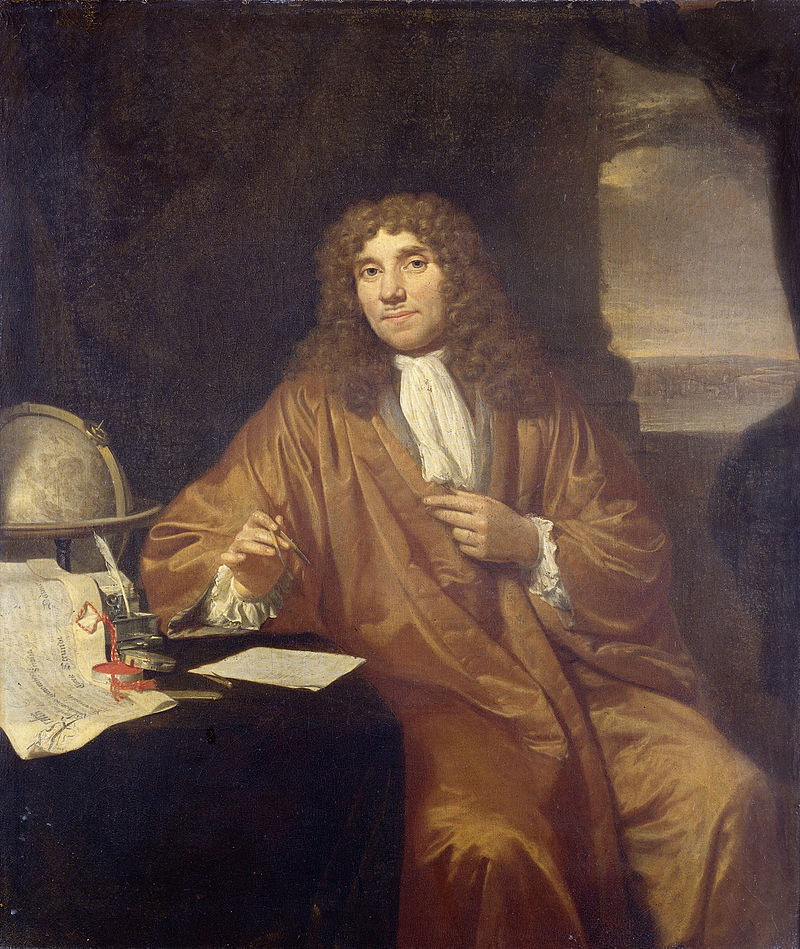
Antonie van Leeuwenhoek and microscopic life


Photo source: Wikimedia Commons, Jan Verkolje

Antonie van Leeuwenhoek (1632-1723) was a Dutch microbiologist best known for his contributions to microscopy and the discovery of many microscopic organisms. Antiquarian Martin Folkes said,
"We have seen so many, and those of [Leeuwenhoek's] most surprising discoveries, so perfectly confirmed by great numbers of the most curious and judicious observers, that there can surely be no reason to distrust his accuracy in those others which have not yet been so frequently or carefully examined." (Account of Mr. Leeuwenhoek's Microscopes, 1723)
The rest of this post is some quotes from Leeuwenhoek.

Microscopic life


"...I judge that some of these little creatures were above a thousand times smaller than the smallest ones I have ever yet seen, upon the rind of cheese, in wheaten flour, mould, and the like." (Letter to the Royal Society, 1674)

"...we see little living animals and see their legs and must judge the same to be ten thousand times thinner than a hair of my beard, and when I see animals living that are more than a hundred times smaller and am unable to observe any legs at all, I still conclude from their structure and movements of their bodies that they do have legs." (Letter to N. Grew, 1678)

"I observed certain animalcules, within whole bodies I saw so quick a motion as to exceed belief; they were about the size of a large grain of sand, and their bodies being transparent, that the internal motion could plainly be seen. Among other things, I saw in the body of one of these animalcules a bright and round corpuscle, placed near the head, and in which a very wonderful swift motion was to be seen, consisting of an alternate extension and contraction. This particle I concluded to be the heart." (AZQuotes.com)

"If we reflect that a small creature such as this is provided, not only with external members, but also with intestines and other organs, we have no reason to doubt that a like creature, even if a thousand million times smaller, may already be provided with all its external and internal organs... though they may be hidden from our eyes." (Letter to the Royal Society, 1685)

Is reality infinitely microscopic?


"How little do we discover in comparison of those things which now are and forever will be hidden from our sight? The whole of which I am fully persuaded no one will ever be able to dive into, and to explain their causes and effects." (Brainyquote.com)

"How inscrutable and incomprehensible are the hidden works of Nature!" (Brainyquote.com)

James Watt and thinking


Photo source: Wikimedia Commons, Carl Friedrich Breda

James Watt (1736-1819) was a Scottish inventor best known for his contributions to the stream engine. Economist Jeremy Rifkin said,
"James Watt patented his steam engine on the eve of the American Revolution, consummating a relationship between coal and the new Promethean spirit of the age, and humanity made its first tentative steps into an industrial way of life that would, over the next two centuries, forever change the world." (Quoted in The Hydrogen Economy)
Chemist Humphry Davy said,
"Those who consider James Watt only as great practical mechanic form a very erroneous idea of his character: he was equally distinguished as a natural philosopher and a chemist, and his inventions demonstrate his profound knowledge of those sciences, and that peculiar characteristic of genius, the union of them for practical application." (Quoted in Proceedings of the Public Meeting held at Freemasons Hall, 1824)
The rest of this post is some quotes from Watt.

Thinking


"I can think of nothing else than this machine." (Letter to Dr. Lind, 1765)

"I had gone on a walk on a fine Sabbath afternoon... I was thinking upon the engine at the time, and had gone as far as the herd's house, when the idea came into my mind that as steam was an elastic body it would rush into a vacuum, and if a communication were made between the cylinder and an exhausted vessel it would rush into it, and might be there condensed without cooling the cylinder." (Quoted in Reminiscences of James Watt by Robert Hart)

"When once the idea of the separate condensation was started, all these improvements followed as corollaries in quick succession, so that in the course of one or two days the invention was thus far complete in my mind, and I immediately set about an experiment to verify it practically." (Notes on Professor Robison's Dissertation on Steam-engines, 1769)

Steam engine


"It now appeared that the cylinder of the model, being of brass, would conduct heat much better than the cast-iron cylinders of larger engines (generally covered on the inside with a stony crust), and that considerable advantage could be gained by making the cylinders of some substance that would receive and give out heat slowly." (Notes on Professor Robison's Dissertation on Steam-engines, 1769)

"I perceived that, in order to make the best use of steam, it was necessary - first, that the cylinder should be maintained always as hot as hot as steam which entered it; and, secondly, that when the steam was condensed, the water of which it was composed, and then injection itself, should be cooled down to 100 degrees, or lower, where that was possible." (Notes on Professor Robison's Dissertation on Steam-engines, 1769)

"There still remained another source of the destruction of steam, the cooling of the cylinder by the external air, which would produce an internal condensation whenever the steam entered it, and which would be repeated every stroke; this I proposed to remedy by an external cylinder, containing steam, surrounded by another of wood, or of some other substance which would conduct heat slowly." (Notes on Professor Robison's Dissertation on Steam-engines, 1769)

Joseph-Louis Lagrange and arithmetic


Photo source: Wikimedia Commons

Joseph-Louis Lagrange (1736-1813) was an Italian mathematician best known for his contributions to analysis, number theory and classical mechanics. Writer Johann Wolfgang von Goethe said,
"The mathematician is perfect only in so far as he is a perfect being, in so far as he perceives the beauty of truth; only then will his work be thorough, transparent, comprehensive, pure, clear, attractive and even elegant. All this is necessary to resemble Lagrange." (Wilhelm Meister's Wanderjahre, Zqeites Buck)
Mathematician Dirk Jan Struik said,
"Full use of Lagrange's own calculus of variations made the unification of the varied principles of statistics and dynamics possible - in statistics by the use for the principle of virtual velocities, in dynamics by the use of D'Alembert's principle." (A Concise History of Mathematics, 1948)
The rest of this post is some quotes from Lagrange.

Arithmetic and geometry


"An ancient writer said that arithmetic and geometry are the wings of mathematics; I believe one can say without speaking metaphorically that these two sciences are the foundation and essence of all the sciences which deal with quantity." (Dans Les Lecons Elementaires sur les Mathematiques, 1795)

"As long as algebra and geometry proceed along separate paths, their advance was slow and their applications limited. But when these sciences joined company, they drew from each other fresh vitality and thenceforward marched on at a rapid pace toward perfection." (Dans Les Lecons Elementaires sur les Mathematiques, 1795)

"We have already various treatises on Mechanics, but the plan of this one is entirely new... The methods that I explain require neither geometrical, nor mechanical, constructions or reasoning, but only algebraical operations in accordance with regular and uniform procedure." (Quoted in Mathematics, from the points of view of the Mathematician and of the Physicist, 1912)

Applied knowledge


"I regarded as quite useless the reading of large treatises of pure analysis: too large a number of methods pass at once before the eyes. It is in the works of application that one must study them; one judges their utility there and appraises the manner of making use of them." (Quoted in Moniteur Universel by J. F. Maurice)

History of science


"Newton was the greatest genius that ever existed, and the most fortunate, for we cannot find more than once a system of the world to establish." (Introduction to Astronomy by F. R. Moulton)

"It took them only an instant to cut off that head, but France may not produce another like it in a century." (Quoted in Annual Editions: Western Civilization by William Hughes regarding the beheading of Antoine Lavoisier)

Pierre de Fermat and number theory


Photo source: Wikimedia Commons

Pierre de Fermat (1607-1665) was a French mathematician best known for Fermat's Last Theorem and his contributions to number theory and calculus. Physicist Isaac Newton said,
"I had hints of this method [of fluxions] from Fermat's way of drawing tangents, and by applying it to abstract equations, directly and invertedly, I made it general." (Quoted in Isaac Newton by Louis Trenchard More)
Regarding Fermat's Last Theorem, Wikipedia says,
"In number theory, Fermat's Last Theorem... states that no three positive integers A, B, and C satisfy the equation A^N + B^N = C^N for any integer value of N greater than 2. The cases N=1 and N=2 have been known to have infinitely many solutions since antiquity." (Wikipedia: Fermat's Last Theorem, 8.11.21 UTC 03:24)
Mathematician Andrew Wiles wrote the proof to Fermat's Last Theorem in 1993, which was regarded as a major event in the history of mathematics. Wiles said,
"The best problem I ever found, I found in my local public library. I was just browsing through the section of math books and I found this one book, which was all about one particular problem - Fermat's Last Theorem." (Nova Interview, 2000)
The rest of this post is some quotes from Fermat.

Number theory


"There is scarcely any one who states purely arithmetical questions, scarcely any one who understands them. Is this not because arithmetic has been treated up to this time geometrically rather than arithmetically? ... If they succeed in discovering the proof or solution, they will acknowledge that questions of this kind are not inferior to the more celebrated ones from geometry either for depth or difficulty or method of proof..." (Letter to Frenicle de Bessy, 1657)

"It is impossible for any number which is a power greater than the second to be written as a sum of two like powers." (AZQuotes.com)

"To divide a cube into two other cubes, a fourth power, or in general any power whatever into two powers of the same denomination above the second is impossible..." (AZQuotes.com)

"...given any number which is not a square, there also exists an infinite number of squares such that when multiplied into the given number and unity is added to the product, the result is a square." (Letter to Frenicle de Bessy, 1657)

Alan Turing and artificial intelligence


Photo source: Wikimedia Commons

Alan Turing (1912-1954) was an English computer scientist and mathematician best known for contributions to computers and artificial intelligence. Philosopher Jerry Fodor said,
"Beyond any doubt, the most important thing that has happened in cognitive science was Turing invention of the notion of mechanical rationality." (The Trouble with Psychological Darwinism, 1998)
Mathematician James Wilkinson said,
"Turing had a strong predilection for working things out from first principles, usually in the first instance without consulting any previous work on the subject, and no doubt it was this habit which gave his work that characteristically original flavor." (Some Comments from a Numerical Analyst, 1970)
The rest of this post is some quotes from Turing.

Artificial intelligence


"If one wants to make a machine mimic the behaviour of the human computer in some complex operation one has to ask him how it is done, and then translate the answer into the form of an instruction table. Constructing instruction tables is usually described as 'programming'." (Computing Machinery and Intelligence, 1950)

"We may hope that machines will eventually compete with men in all purely intellectual fields. But which are the best ones to start with? Many people think that a very abstract activity, like the playing of chess, would be best. It can also be maintained that it is best to provide the machine with the best sense organs that money can buy, and then teach it to understand and speak English." (AZQuotes.com)

"It seems probable that once the machine thinking method had started it would not take long to outstrip our feeble powers... They would be able to converse with each other to sharpen their wits. As some stage therefore, we should have to expect the machines to take control." (Goodreads.com)

"I believe that at the end of the century the use of words and general educated opinion will have altered so much that one will be able to speak of machines thinking without expecting to be contradicted." (Computing Machinery and Intelligence, 1950)

Turing test


"A computer would deserve to be called intelligent if it could deceive a human into believing that it was human." (AZQuotes.com)

Mathematics


"Mathematical reasoning may be regarded rather schematically as the exercise of a combination of two facilities, which we may call intuition and ingenuity... The exercise of ingenuity in mathematics consists in aiding the intuition through suitable arrangements of propositions, and perhaps geometrical figures or drawings." (System of Logic Based on Ordinals, 1938)

"...we are regarding the function of the mathematician as simply to determine the truth or falsity of propositions." (System of Logic Based on Ordinals, 1938)

Archimedes and mathematical physics


Photo source: Wikimedia Commons, Andre Thevet

Archimedes (287-212 BC) was a Greek mathematician and physicist best known for using proofs in geometry and his contributions to mathematical physics. Mathematician Alfred North Whitehead said,
"Some of the later Greeks, such as Archimedes, had just views on the elementary phenomena of hydrostatics and optics. Indeed, Archimedes, who combined a genius for mathematics with physical insight, must rank with Newton, who lived nearly two thousand years later, as one of the founders of mathematical physics." (An Introduction to Mathematics, 1911)
Astrophysicist Mario Livio said,
"Using his masterful understanding of mechanics, equilibrium, and the principles of the lever, he weighed in his mind solids or figures whose volumes or areas he was attempting to find against ones he already knew. After determining in this way the answer... he found it much easier to prove geometrically... [He] essentially introduced the concept of a thought experiment into rigorous research." (Is God a Mathematician, 2009) 
The rest of this post is some quotes from Archimedes.

Epistemology


"Those who claim to discover everything but produce not proofs of the same may be confuted as having actually pretended to discover the impossible." (On Spirals, 225 BC)

"How many theorems in geometry which have seemed at first impracticable are in time successfully worked out?" (On Spirals, 225 BC)

"Mathematics reveals its secrets only to those who approach it with pure love, for its own beauty." (AZQuotes.com)

"Man has always learned from the past. After all, you can't learn history in reverse." (AZQuotes.com)

Physics


"Equal weights at equal distances are in equilibrium and equal weights at unequal distances are not in equilibrium but incline towards the weight which is at the greater distance." (On the Equilibrium of Planes)

"Two magnitudes whether commensurable or incommensurable, balance at distances reciprocally proportional to the magnitudes." (On the Equilibrium of Planes)

"It follows at once from the last proposition that the centre of gravity of any triangle is at the intersection of the lines drawn from any two angles to the middle points of the opposite sides respectively." (On the Equilibrium of Planes)

Pythagoras and the origins of philosophy


Photo source: Wikimedia Commons, Szilas

Pythagoras (570-496 BC) was a Greek philosopher and mathematician best known for the Pythagorean theorem and the Pythagoreanism movement. Philosopher Bertrand Russell said,
"The combination of mathematics and theology, which began with Pythagoras, characterized religious philosophy in Greece, in the Middle Ages, and in modern times down to Kant... I do not know of any other man who has been as influential as he was in the sphere of though. I say this because what appears as Platonism is, when analyzed, found to be in essence Pythagoreanism." (A History of Western Philosophy, 1945)
The rest of this post is some quotes from Pythagoras.

Mathematics


"Number is the ruler of forms and ideas, and the cause of gods and daemons." (Quoted in Life of Pythagoras by Iamblichus of Chalcis)

"There is geometry in the humming of the strings, there is music in the spacing of the spheres." (Quoted in The Mystery of Matter by Louise Young)

Knowledge


"Reason is immortal, all else mortal." (Quoted in Lives and Opinions of Eminent Philosophers by Diogenes Laertius)

"The soul of man is divided into three parts: intelligence, reason and passion. Intelligence and passion are possessed by other animals, but reason by man alone." (Quoted in Lives and Opinions of Eminent Philosophers by Diogenes Laertius)

"The oldest, shortest words - 'yes' and 'no' - are those which require the most thought." (Quoted in Numerology for Relationships: A Guide to Birth Numbers by Vera Kaikobad)

"When the wise man opens his mouth, the beauties of his soul present themselves to the view, like the statues in a temple." (Quoted in Pythagorean Ethical Sentences From Stobaeus by Florence Firth)

Ethics


"The most momentous thing in human life is the art of winning the soul to good or to evil." (Quoted in Lives and Opinions of Eminent Philosophers by Diogenes Laertius)

"Educate the children and it won't be necessary to punish the men." (Quoted in Geary's Guide to the World's Greatest Aphorists by James Geary)

"Above all things reverence thy Self." (The Golden Verses)

"As long as Man continues to be the ruthless destroyer of lower living beings, he will never know health or peace. For as long as man massacre animals, they will kill each other. Indeed, he who sows the seed of murder and pain cannot reap joy and love."  (Quoted in The Extended Circle: A Dictionary of Humane Thought by Jon Wynne-Tyson)