Saturday, July 14, 2018

What is data?


Photo source: Wikimedia Commons, Morton Bisgaard

What is data? Here is my definition:
Data is rudimentary information
I believe that data is the root source of all knowledge. Everything we know about reality was originally received as data through a sense. Data is the most basic material we use to construct our beliefs about reality.

License: CC BY-SA 4.0

Thursday, July 12, 2018

What is a symbol?


Photo source: Wikimedia Commons

What is a symbol? Here is my definition:
A symbol is something that represents a concept
I believe that behind every symbol is a concept. Symbols are portable concepts. In this regard, symbols are useful for communicating efficiently and making propositions.

Although many symbols are completely abstract (such as the peace sign), there are some symbols that have a physical relation to the meaning. For example, imagine the up arrow symbol. This symbol resembles the thing it represents. In this regard, the up arrow symbol is not abstract.

License: CC BY-SA 4.0

What is a sign?

Photo license: CC BY-SA 4.0

What is a sign? Here is my definition:
A sign is something that indicates something else
I believe that a sign is something that provides knowledge without itself being the knowledge. For example, imagine that you see a grocery bag full of food in the kitchen. This is a sign that one of your roommates recently bought food at the grocery store. Another example, imagine that you see a store that looks dark inside. This is a sign that the store is closed.

How does this apply to street signs? A street sign conveys knowledge in an abstract form without being the knowledge itself. For example, imagine that you see a sign that says 'detour ahead'. This sign is not the detour itself, but instead it is an indication of the detour.

License: CC BY-SA 4.0

Wednesday, July 11, 2018

What is a priori, a posteriori, analytic and synthetic?


Photo source: Wikimedia Commons, Viet Hans Schnorr

What is a priori, a posteriori, analytic and synthetic? I have 4 definitions below:
A priori knowledge is acquired without experience
A posteriori knowledge is acquired through experience
Analytic knowledge is the meaning of a concept
Synthetic knowledge extends beyond the meaning of a concept
Using these four definitions, we can divide knowledge into four types: a priori analytic, a priori synthetic, a posteriori analytic and a posteriori synthetic.

Before describing each type of knowledge, I should mention that I believe all thoughts are experiences. This makes all thoughts a posteriori knowledge. For example, imagine that you're climbing a mountain and when you get to the top, you have the thought that you've accomplished a great feat and you're proud of yourself. I believe that this conscious awareness is an experience. The same goes for any emotion or idea you experience.

A priori analytic

A priori analytic is knowledge of the meaning of a concept without experience. I believe that a priori analytic knowledge doesn't exist, because all definition retrieval occurs within the bounds of experience. For example, imagine that you ask yourself the meaning of the word 'fence'. To answer this question, your mind needs to retrieve a mental representation of what 'fence' means. I believe this definition retrieval would be an experience, thereby making it a posteriori knowledge.

A priori synthetic

A priori synthetic is knowledge that extends beyond the meaning of a concept without experience. I believe that a priori synthetic knowledge doesn't exist, because I regard all mental activity as an experience. In this regard, every belief that I have about reality was initially based on a previous experience in my life.

I also believe that mathematical equations are known a posteriori. For example, take the equation 86 + 14 = __. To demonstrate this, imagine that you combine 86 apples with 14 apples and then count the total. Even if you count the same total a million times in a row, there is still a chance that you miscounted every time. Even if you do this exercise entirely in your mind, you could potentially make the same mistake. We need experience (physical or mental) to determine the answer. For this reason, I believe that all mathematical equations are known a posteriori.

A posteriori analytic

A posteriori analytic is knowledge of the meaning of a concept through experience. For example, imagine that you ask yourself the meaning of the word 'rock'. To answer this question, your mind needs to retrieve a mental representation of what 'rock' means. This inquiry would tap into your past experiences and look for instances when objects were labeled as a 'rock'. I believe this picture retrieval would be an experience, therefore making it a posteriori knowledge.

A posteriori synthetic

A posteriori synthetic is knowledge that extends beyond the meaning of concept through experience. For example, think about this proposition: There is a bowl in the kitchen. This proposition is synthetic because the definition of 'bowl' doesn't include 'in the kitchen'. This proposition is also a posteriori because it would be impossible to know whether it was true or false without first-hand experience or mental reasoning.

License: CC BY-SA 4.0

What is a perception?


Photo source: Wikimedia Commons, Woodwalker
Photo license: CC BY-SA 3.0

What is a perception? Here is my definition:
A perception is a conscious sense datum
In our daily lives, we are exposed to a large amount of sense data. Derived from our immediate environment, our senses are always taking in new data. Of course, not every piece of sense data receives conscious attention. In this regard, we are unaware of most of the data we encounter. The moment that a datum captures our attention, it becomes a perception.

License: CC BY-SA 4.0

What is experience?


Photo source: Wikimedia Commons, Rene Descartes

What is experience? Here is my definition:
Experience is the totality of past and present sense data
I believe that experience is the only thing we know in life. It's impossible to perceive anything without it being an experience. In this regard, I also believe that our inner thoughts are an experience. For example, imagine that while working in an office, you walk over to the water fountain, get some water and return to your desk. Once you are back at your desk, you can reflect on the individual thoughts going through your head during your trip to the water fountain. This is why I believe we experience our own thoughts.

License: CC BY-SA 4.0

Sunday, July 1, 2018

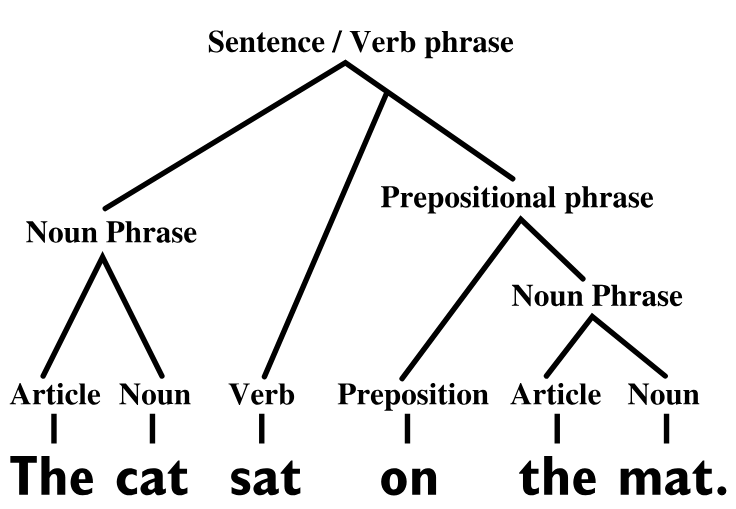
What is a sentence?


Photo source: toppr.com

What is a sentence? Here is my definition:
A sentence is an unified segment of words that has at least one subject-predicate pair and follows grammatical rules
The subject of a sentence is the piece of reality that is selected, while the predicate describes that piece. For example, in the sentence 'John ran to the store', 'John' is the subject and 'ran to the store' is the predicate. Some sentences have multiple subject-predicate pairs such as, 'John ran to the store but the store was closed'.

Some sentences have an implied subject or predicate. For example, in the sentence 'Pay your taxes', the subject 'you' is implied and part of the predicate, 'should' is also implied.

I believe that the only syntactic rule common to all languages is the subject-predicate pair. When comparing languages from around the world, you will not find a uniform consistency in the way words are ordered. The only syntactic consistency you will find is the subject-predicate pair.

License: CC BY-SA 4.0